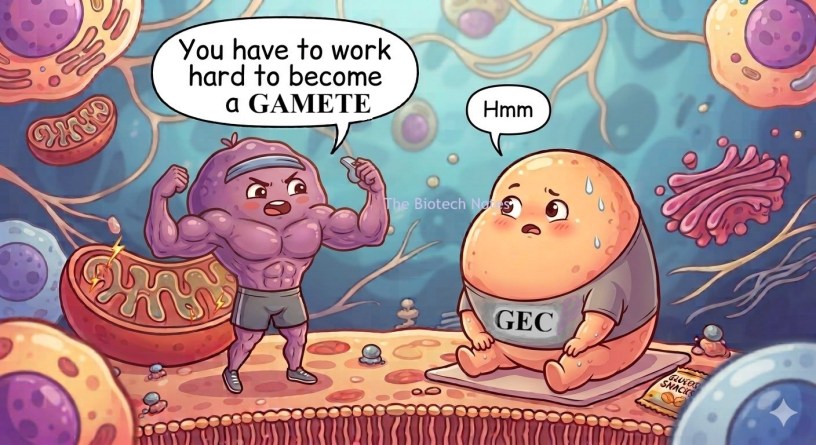
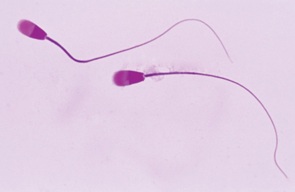
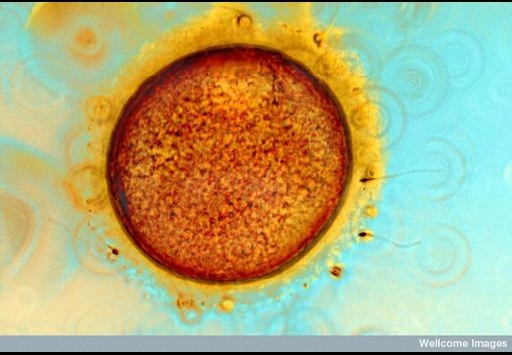
Gamete is the haploid reproductive cell of animals or plants. Gregor Mendel coined the name ‘gamete’, which is derived from ancient Greek literature (gametes meaning ‘husband’ and gamete meaning ‘wife’). In the sexually reproducing organisms, the gametes of the two opposite sexes undergo fertilization, wherein the male gamete (sperm/spermatozoa) fuses with female gamete (egg/oocyte). This fusion produces a diploid cell called a zygote, which further develop into a new individual.
Gametogenesis is a process in which the haploid gametes are formed from the diploid germ cells of the body. These germ cells are present in the reproductive organs of the individual. In most of the higher animals, it arises in the germinal epithelium of the gonads.
The formation of the germ cells can be traced during the early stages of cleavage (of zygote). These primordial germ cells or the embryonic precursor cells give rise to gonads of the individual during the growth of the embryo. Later, some of the germinal epithelium cells of the gonads differentiates into a large number of primary spermatogonia or oogonia. Some of the germinal cells differentiate to form the supportive cells.
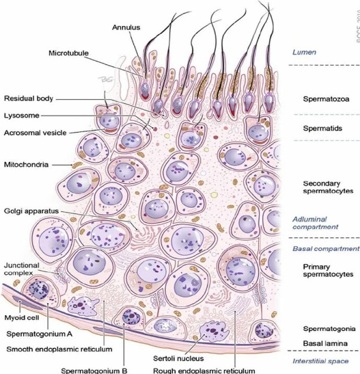
The spermatogonia and the oogonia further mature to form the haploid gametes. The haploid gametes thus formed is the large sized, non-motile, nutrient-filled cell the ovum or egg (egg) in female or smaller, motile cell called sperm in male.
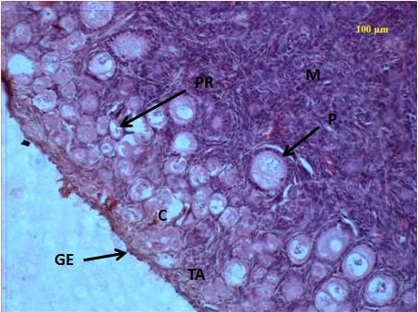
Fig 4: Photomicrograph of ovary showing germinal epithelium (GE). (Image source: Minj, et al (2016)).
The process of production of the gametes, that is the gametogenesis, in both the sexes is different. However, they can be subdivided into different stages, which are common to both. They are as follows:
(1) Multiplication: Primordial germ cells undergo mitosis and produce a large number of spermatogonia or oogonia. These cells are diploid and allow constant source of large number precursor cells, which later mature to form gametes.
(2) Growth: This includes sex-specific events of germline development and differentiation. They occur in the individual (male or female) after the birth. The processes are known as oogenesis in females and spermatogenesis in males. During this stage, the size of the cell increases, due to absorption of nutritive materials from surrounding and activities of nucleic acid and proteins. The cells are still diploid as no change in number of chromosomes. However, splitting of chromosomes, linkage and crossing over also takes place. After this stage the cells are called as primary spermatocytes (in males) and primary oocyte (in females).
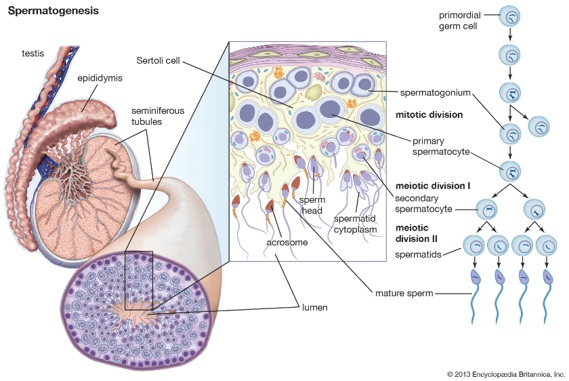
(3) Meiosis: This step yields the haploid gametes in each sex from the diploid precursors. The genetic recombination takes place during meiosis. Meiosis in male germ cells begins at the onset of puberty, whereas in females it starts during embryonic development (fetal stage) inside the womb but is arrested at different stages.
(4) Maturation: Post-meiotic gametogenesis includes the final sexually dimorphic stages of differentiation of the gametes to form the mature functional gametes.
Let us go through the steps of gametogenesis in each of the sex, spermatogenesis in males and oogenesis in females in the coming posts.
–
This is all for this post. Hope u like this post, if yes, please comment, like and share!!
Also follow us on Facebook, Twitter, Instagram or send an email to thebiotechnotes@gmail.com.
Have a nice day!
Thank you!!
Read other posts by The Biotech Notes:
High Pressure Liquid Chromatgraphy (HPLC).
–
References:
Abdelhamid et. al. (2019). Effects of exogenous factors on male gametes and genomes: potential consequences of mild temperature increase in testis and epididymis on the quality of the gamete. 10.70675/2d263cd7z027ez4843z912dz92bf1e6ee948.
Sharma and Agarwal (2011) Spermatogenesis: An overview. Sperm chromatin. Springer, New York (19-44).
Minj et. al. (2016) Effect of light and dark shift on postnatal development of ovary in rabbit (Oryctolagus Cuniculus). Indian Journal of Animal Research. 50. 10.18805/ijar.8424.
McCarrey (2018) Gametogenesis Overview. Encyclopedia of Reproduction. 2nd Edition. Academic Press (2-4)
Singh and Sarkar (2013) Gametes, Mammalian, Encyclopedia of Genetics (2nd Edition), Academic Press (149-150).
Inbar (2011) Meiosis in Humans. Embryo Project Encyclopedia (2011-03-24). ISSN: 1940-5030 https://hdl.handle.net/10776/2084
Spermatogenesis. Encyclopaedia Britannica. https://www.britannica. com/ science/spermato genesis#/media/1/559418/143155
Human sperm cells (2026) Encyclopædia Britannica. https://www.britannica .com/science/spermatogenesis #/ media/1/ 559418/127452
Digital Object Identifier. doi:10.7295/W9CIL39092. ark:/b7295/w9cil39092. https://www.cellimagelibrary.org/images/39092
Kiran (2021) Ch 4: Ovarian reserve. Subfertility. Elsevier (77-95). https://doi.org/10.1016/B978-0-323-75945-8.00004-9.

